Craft beer on the rise
- isabelleoconnell

- Dec 3, 2019
- 4 min read
Updated: Dec 16, 2019
A guitarist and singer play Free Fallin by John Mayer. Families, couples, and friends gather around the bar, enjoying craft beer. A group of girls walk in to La Cueva del Faisán, a local bar in Madrid, and order four ‘Blue Mojitos.’ The musicians finish their song. They stop to take a sip of their beer before starting the next song.
“Can I please have any type of craft beer,” asked Ryan Shepard, an international student from Washington D.C., United States. Shepard explained that the craft beer he has had so far in Madrid does not compare to anywhere else. “The craft beer here has a much more homey taste,” Shepard said. “It is also much cheaper than other places I have purchased craft beer at before.”

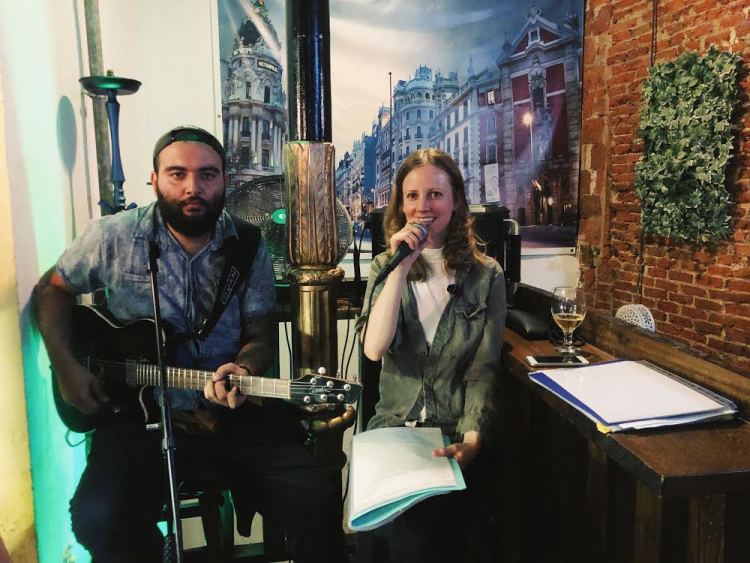
Two musicians singing at La Cueva del Faisán. Taken by: Isabelle O’Connell
After living in Madrid for a month, Shepard discovered the two main reasons why craft beer is thriving in Madrid’s current economy. Between 2008 and 2016, the number of microbreweries in Spain grew by more than 1,600% according to The Trans-Iberian, an independent blog now found on El País in English, a Spanish daily newspaper in English. The economic crisis of 2008 pushed the unemployment rate in Spain to over 20%, according to The Trans-Iberian.
“Many people were forced to look for a new form of work,” said Nicole Pena, a waitress at La Lateral, a local restaurant and bar in Madrid. “I think it created an opportunity for young people with a passion for the restaurant and bar industry.”
Today, Spaniards focus on craft beer, known as cerveza artesanal. Craft beer is a general term used when referring to the way beer is brewed. Craft beer is brewed through a method that respects the natural process and fermentation, without the use of enzymes and other adjuncts to speed up the process.
Crafting the perfect craft beer is a long process. “David and I have a similar story to many brewers,” said Patrick Tuck, the co-owner of a local tap room bar in Madrid called La Osita. “Brewing at home, tweaking recipes, sharing bottles with friends before moving onto larger professional equipment,” Tuck told the Madrid Metropolitan.
Tuck and his partner, David Ross, saw the opportunity for beer entrepreneurs in Madrid. The two moved from London in 2017 to open a tap room in Madrid.


Photo of the bar at La Lateral. Taken by: Isabelle O’Connell
Trending neighborhoods in Madrid such as Malasaña, Chueca and La Latina were among the first to entrepreneurs to open smaller bars, according to The Trans-Iberian. At night, locals and international visitors occupy the streets of these neighborhoods, moving from bar to bar.
“The best thing about Madrid bars is that you can find multiple nationalities from different parts of the world,” said Moaid Shwerif, a 25 year-old from Libya. “The bars have become increasingly popular in the past years.”
As of 2013, Spain had one bar for every 132 of its 47.2 million inhabitants, according to The Local, a local Spanish news outlet in English. As of 2018, the number of drinking establishments in Spain fell for the seventh year in a row. Since 2010, Spain overall has 18,269 fewer bars, according to El País in English.
Despite this decline, craft beer breweries are going steady.
After the economic crisis of 2008, Spaniards were limited with their money. They began spending their money on smaller purchases that brought them happiness. The average price for a pint of beer in Madrid was $5.70 in 2018, according to Statista, the number one Global Business Data Platform. This price was the eighth cheapest out of all European cities.
“Another thing that I like about Madrid bars is the prices,” said Shwerif. “The prices are kind of cheap compared to other European countries such as England and France.”
Additionally, locals and international visitors continue to support local bars in Madrid because of the relationships they build with employees.
A study by Coca-Cola in 2013 revealed that two thirds of Spaniards claim to know the name of the waiter in their favorite bar. Thirty percent of the 2,000 people who participated in the study said they trust the waiter at their favorite bar enough to give them their house key, according to The Local.
The same remains true six years later.
“I have been coming here as my go-to place for a while now,” said Nicolás Velez, referring to how long he has been going to Irreale, a local bar in Madrid dedicated solely to craft beer. “The waiters are always informative and always help me pick out new beers to try,” Velez said.
Coca-Cola’s study found that more than half of the participants said they regularly visited bars, despite the economic crisis. Thirty-six percent of participants said they visited, “several times a week,” and 5% said they go, “more than once a day,” according to The Local. “I try to go to bars as much as possible,” said Shepard. “Going to bars has helped me meet many locals as well as international students like myself.”


Ryan Shepard enjoying a beer. Taken by: Isabelle O’Connell
“Ryan has been coming here since early September,” said Christian Hernandez, a bartender at La Cueva del Faisán. “He is not only a customer, but a friend.”


Comments